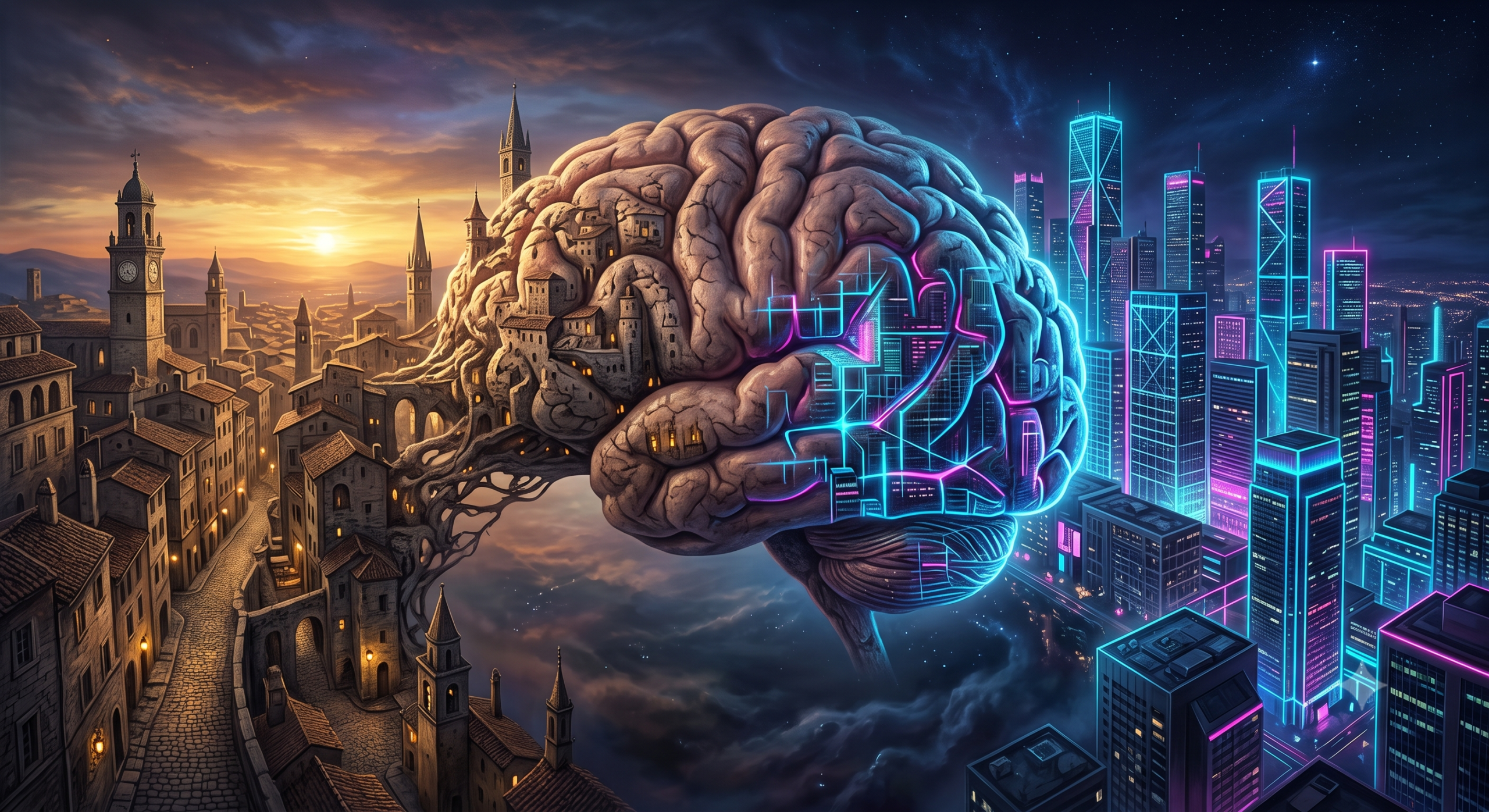
Winston Churchill once made a profoundly unsettling observation:
“We shape our buildings; thereafter they shape us.”
1. We Become What We See (The Architecture of the Mind)
Imagine standing in the historic, tightly-packed neighborhoods of Pune in India, known as Peths. The streets are narrow, the traditional heritage homes (Wadas) share common walls, and people live in close proximity. If humans live in such a space for centuries, how does their brain wire itself?
It automatically becomes highly ‘social’. In such spaces, there is less privacy but a massive sense of ‘community’. The very architecture of these narrow alleys planted a deep, inquisitive interest in other people’s lives within the minds of the locals.
But this isn’t just about Pune. The way ‘Spatial Determinism’ (the idea that geography shapes human behavior) works globally is absolutely fascinating—and a little terrifying.
2. The Streets of Paris: Sown with Control, Not Romance
When you think of Paris, you imagine wide, beautiful boulevards and couples walking hand-in-hand. We naturally assume this city was built for love.
But the historical truth is quite ruthless. Before 1853, Paris was a chaotic maze of narrow, winding, medieval alleys. Whenever the working class rebelled, it was incredibly easy for them to build barricades in these tight streets and block the military.
While pitched to the public as a way to improve sanitation and air circulation to fight disease, the primary motivation for the city’s redesign was much darker. To permanently crush rebellions, an official named Georges-Eugène Haussmann essentially demolished the old Paris. He built the famous wide, straight avenues so that the military and artillery cannons could easily move through the center of the city without obstruction.
What did this architectural shift achieve? It broke the unity and the close-knit neighborhoods of the working class. People were suddenly distanced from one another. On those wide avenues, the individual began to walk alone. What we perceive today as the ultimate symbol of romance and personal freedom was originally a dictator’s master stroke for military control! Cities don’t just hold our history; they hijack our emotions.
3. The NYC Grid: A Factory Turning Time into Money
Now, think about Manhattan in New York. A perfect grid system of intersecting streets. No curves, no natural flow. When the Commissioners’ Plan of 1811 mapped this out, there was no grand cultural vision. The sole purpose was to divide the land into neat rectangular plots to sell real estate as fast as possible.
But what did this ‘perpendicular’ layout do to the human brain?
When you live in a purely rectangular, straight-line city, your brain becomes highly ‘transactional’. In a grid, your only goal is to get from Point A to Point B using the shortest possible path.
“Time is money.”
This mentality wasn’t just born out of capitalism; it was born on these perpendicular streets where there was simply no physical space left to pause, rest, or spark a random conversation. The streets lost their curves, and humans lost their organic urge to connect.
4. The ‘Google Map’ in Our Brain: The Biggest Secret
At this point, you might ask, “But what is the direct, scientific link between the physical street and my thoughts?”
This is where science has made an unsettling discovery. In 2014, scientists won the Nobel Prize for discovering ‘Grid Cells’—the internal navigation system in our brains that helps us understand physical space and directions. Recent neuroscience reveals that our brain uses these exact same cells to map out ‘social hierarchies’ and relationships!
The implication is massive:
- If you grow up in a city where buildings and streets are strictly divided by class (upper vs. lower), your brain subconsciously begins to view social relationships through a ‘superior vs. inferior’ lens.
- If you sit on the 40th floor of a corporate glass tower, your environment subtly primes your thoughts to become more competitive and isolated; if you sit in a ground-floor heritage home, they naturally lean towards community and tradition.
Who Are We, Really?
When we connect these dots, we realize that we are quite literally lost in the concrete jungles we built.
Systems of power don’t always need strict laws to control human behavior. They just need to design the width of your streets, the direction of your windows, and the height of your ceilings. Once they place you in a specific ‘physical mold’, your thoughts, your anger, and your politics can be easily predicted and shaped.
Cities are not just places where we live; they are giant, slow-moving machines designed to build our minds.
Tomorrow morning, when you step out of your house and walk down your familiar street, pause for just a second. Ask yourself one question:
“Am I walking down this street, or is this street walking through my mind?”